
How do agents work?
How do agents work?


Most conversations about AI and employment focus on what might be lost. But the most important finding in Anthropic’s March 2026 labor market research is about what has not happened yet. The gap between what AI can do and what organizations are actually doing with it is enormous, and it represents the biggest operational opportunity most companies are ignoring.
Anthropic’s research maps two metrics across every major occupational category: theoretical AI coverage (what AI could feasibly automate) and observed AI coverage (what is actually being automated today). The difference between the two is what we call the opportunity gap.
The numbers are striking. In business and finance roles, theoretical coverage approaches 95%, but observed coverage sits below 40%. Computer and math occupations show 94% theoretical feasibility against just 33% real-world deployment. Management, architecture, engineering, legal, education, arts and media — every knowledge-work category shows the same pattern. The red line of actual usage barely registers against the blue line of what is possible.
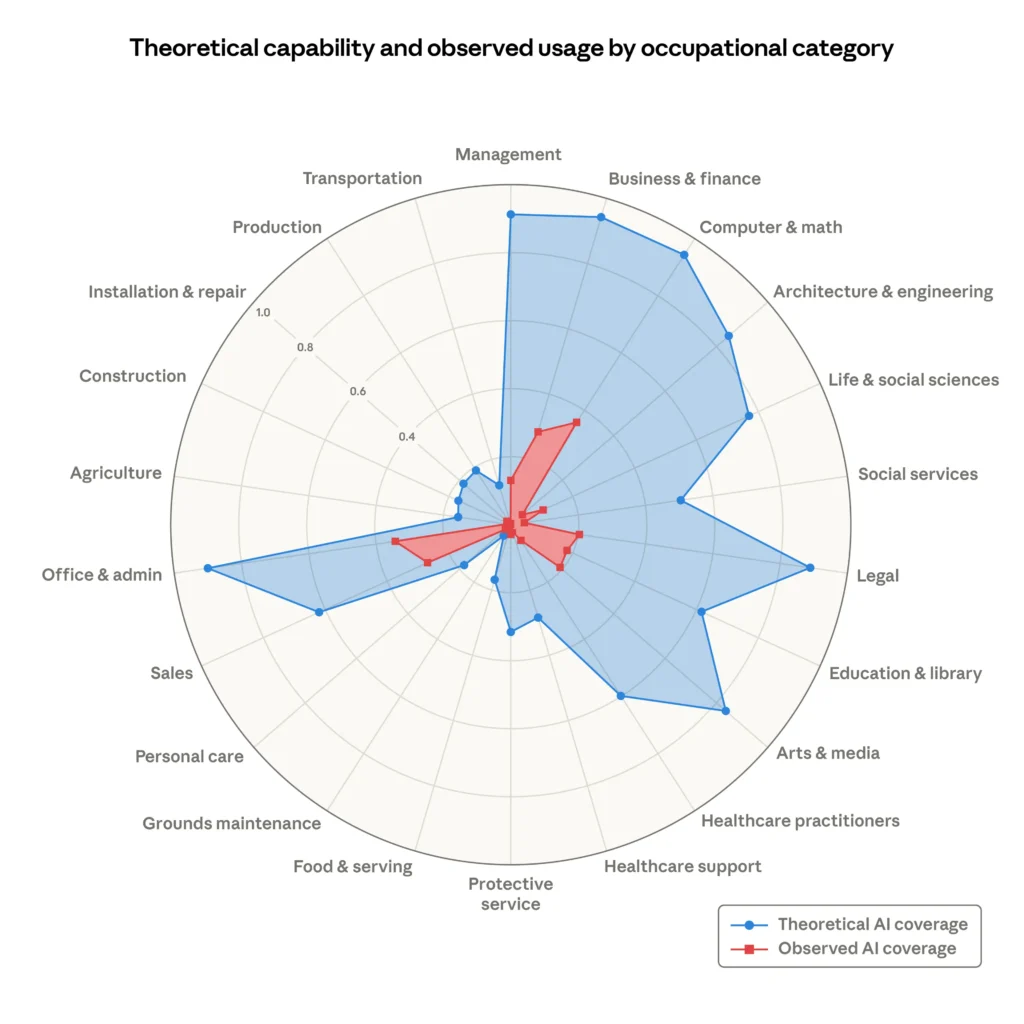
Even the categories with the highest observed coverage — business and finance, computer and math — are using less than half of what is already feasible. And in categories like legal, education, and healthcare, the gap is wider still.
If AI can theoretically handle 94% of tasks in a given field, why is actual usage stuck at 33%? The research points to several factors, but three stand out for business leaders.
Most organizations that experiment with AI use general-purpose tools. These tools can answer questions and generate text, but they do not know your clients, your processes, your tone, or your internal terminology. Without that context, every output requires manual review and correction, which erodes the time savings that justified the tool in the first place.
A chatbot in customer service. A writing assistant in marketing. A summarization tool in legal. These isolated deployments might each handle a few tasks, but they do not communicate with each other. The result is fragmented automation that covers individual tasks rather than end-to-end workflows.
The theoretical coverage numbers assume AI can work across tasks within a role. In practice, that requires coordination: routing outputs from one process into another, maintaining consistent context across interactions, and applying business rules across departments. Without an orchestration layer, each AI tool operates in its own silo.
The research contains several data points that frame the size of this opportunity.
Computer programmers have 75% task coverage, the highest observed exposure of any occupation. That means even in the field most aggressively adopting AI, a quarter of feasible automation remains untapped. For most other knowledge-work roles, the untapped portion is 60% or more.
Workers in highly exposed occupations earn 47% more on average than those in unexposed roles. Graduate degree holders represent 17.4% of the exposed group versus 4.5% in unexposed occupations. This is not about replacing low-cost labor. It is about making your most expensive, highest-judgment employees more effective.
For every 10 percentage point increase in AI coverage, the Bureau of Labor Statistics projects 0.6 percentage points lower employment growth through 2034. Organizations that close their own coverage gap now are building capacity that the labor market will increasingly struggle to provide through hiring alone.
Meanwhile, the research finds no systematic increase in unemployment for highly exposed workers. The disruption is not happening through job losses. It is happening through a growing productivity divide between organizations that implement AI systematically and those that do not.
The difference between 33% coverage and 94% coverage is not a technology problem. The models are capable. The gap is an implementation problem, and it has three components.
Every percentage point of coverage beyond the basics requires business-specific knowledge. Your Interactive Agent needs to know your product catalog, your pricing rules, and your customer segments. Your Pro-Active Agent needs to understand your follow-up cadence, your escalation criteria, and your CRM structure. This context is what closes the gap between a demo that impresses and a deployment that delivers.
The radar chart does not show a gap in one category. It shows a gap across every category simultaneously. That pattern matches what we see with clients: the opportunity is not in one department. It is across the organization. An AI Email Agent handling triage, a Pro-Active Agent managing follow-ups, an Interactive Agent preparing briefings, a Custom Agent running department-specific workflows. Each agent closes the gap in its domain.
When agents share context and coordinate handoffs, coverage compounds. An email that triggers a CRM update that triggers a briefing note that triggers a follow-up task — that is four tasks covered by one inbound event. Without orchestration, each of those tasks requires separate human attention. With it, the coverage percentage climbs toward the theoretical maximum.
The Anthropic data shows macro-level gaps by occupation. Your organization has its own version of this gap, and it is measurable.
List the tasks your most experienced (and expensive) team members spend time on that follow predictable patterns: email triage, report generation, data consolidation, scheduling, status updates, and client communication. These are your highest-ROI automation candidates.
For each task, ask two questions. Can an AI agent do this with the right context? And how many hours per week does it currently consume? Tasks that score high on both are where your gap is widest and the return is fastest.
Pick a workflow that spans at least two tasks. Email triage plus follow-up scheduling. Client inquiry plus CRM update. Meeting preparation plus action item tracking. Starting with a connected workflow rather than an isolated task demonstrates the orchestration advantage from day one.
Track hours reclaimed, error rates, and response times. Use these baselines to make the case for expanding to adjacent workflows. Each workflow you connect increases the value of every agent already deployed, because shared context makes all of them more effective.
The gap between theoretical and observed AI coverage will not stay this wide forever. As more organizations move from experimentation to systematic deployment, the competitive advantage of early adoption shrinks. The research already shows a 14% drop in the job-finding rate for young workers entering AI-exposed occupations — a signal that the market is beginning to price in AI capability.
Right now, most of your competitors are in the same position: aware that AI matters, running a few experiments, but not deploying systematically. That is the window. The organizations that close their gap first will set the standard that others have to catch up to.
An Agent Strategy Scan can map your specific opportunity gap in a single session, identifying which workflows to automate first and which agents to deploy. The research says the potential is there. The question is how fast you move to capture it.
How does Use Your AI deploy AI for any organisation in days?